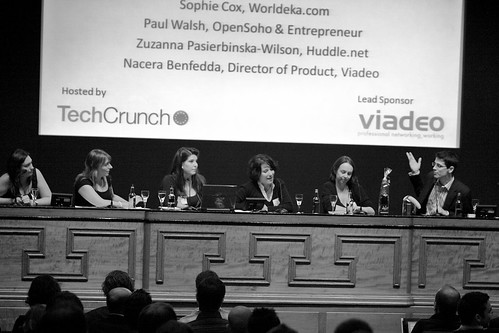
 A wrap-up post collating lots of feedback and thoughts by people who attended Geek’ n Rolla is coming. But one of the most hotly debated issues since the conference on Tuesday has been the panel about Women in Tech, specifically tech startups. Here’s who was on the panel and the original title:
11.50am
Panel: Just a girl – Balancing Tech Culture: Getting more women involved in tech startups
Moderator: Cate Sevilla, BitchBuzz
Panellists:
Leisa Reichelt, User experience consultant
Sophie Cox, Worldeka.com
Paul Walsh, OpenSoho (startups networking event) & Entrepreneur
Zuzanna Pasierbinska-Wilson, Huddle.net
Nacera Benfedda, Director of Product, Viadeo
First some background about why I put this panel together: A long time ago I was a journalist covering the media industry. That business sector was (and is) full of women, probably even over 50%. It is full of smart women contributing to a vibrant industry. I then moved on to writing about new media. In the mid-1990s, admittedly, there were more men than women generally, as it was a more male/geeky environment then. That changed and I would say that the “new media” sector is pretty balanced these days. But over the last few years I have headed profoundly into the tech space and I have been puzzled at the dearth of women involved. It really doesn’t make a lot of sense to me to be honest, and from time to time it pops up in conversations on and off-line. Plus, I think it’s something tech startups should address, not because they are inherently sexist – far from it I would say – but there are huge advantages to be had from tapping into this relatively untapped talent. And sometimes male-led tech startups don’t really *think*. For instance, they will get the cheapest office they can find in the most dangerous part of town and then wonder why they can’t attract any female candidates for that job opening…
So I felt we needed to discuss it. After consulting with lots of people and consulting with the chair, Cate Sevilla, we decided to put the debate slap bang in the middle of a fairly mainstream event for tech companies – GeeknRolla. We could have put it on as a standalone event. But we figured that would just be alienating the subject even further. It needed to be debated by men and women, broadly.
In hindsight we should have balanced the panel with more than one man – and the irony that a bad sore throat cut down our only guy was not exactly invisible. (Paul Walsh was unable to join the panel due to a bout of viral tonsillitis. And yes I replaced him with a banana, hey it was a little joke).
However, we soldiered on. I felt I couldn’t join the panel as I was running the whole day already. So I figured I’d let the panel kick things off their own way. Half way through it became clear that we did need a male voice. Milo Yiannopoulos, a tech blogger with The Daily Telegraph seemed keen, so he volunteered. It wasn’t a bad idea because frankly he provided a fairly opposite-end-of-the-spectrum point of view (to put it mildly).
At that point the audience got fired up and we had some great debate and great questions. Our live blog kicked off a debate. And the next day Yiannopoulos blogged his views again (see below)
Since then, a war of words has kicked off about the whole subject. Frankly, I’m not sure how productive this war is going to be, and Cate and I were keen to find SOLUTIONS to this issue, not just more mud-throwing. But I hope out of this debate that tech companies and startups really do start to *think* about whether they could behave in a more female-friendly way. After all, there are many sound business reasons for doing so. So I’m going to encourage you to get involved in the debate and please go read the posts from these commentators and form you own view, whether you agree with me that that this is an “issue” or not.
Here is our transcript of the debate covered by TechCrunch Europe writer Basheera Khan. Here is a selection of just some of the posts so far:
Telegraph: “Men perform better in many technology jobs. Must we apologise for that? (32 comments)”
As Joshua March pointed out yesterday, since most start-ups are founded by developers, and most developers are men, it’s natural that a lot of the CEOs on the scene are male. But the tech scene is much bigger than the startups themselves: there’s an entire ecosystem of VCs, PRs and journalists. Many of these jobs are done by girls. As Paul Walsh puts it: “The women who want to work in technology are working in technology.”
Manufactured anger over the lack of women in tech (22 comments)
It’s my opinion, which I’ll articulate tomorrow, that the books of males vs females doesn’t need to be balanced in favour of more females. Why? Well, because there are plenty of females in tech and those that aren’t, don’t want to be. Ok, so there might be a small percent who would like to be in tech, but don’t make it. But can’t the same be said for any industry?
Ciara Byrne makes a good comment underneath Yiannopoulos’s blog, saying, “Working in an environment where you are always the only woman (apart from the secretary) does get wearing and you always feel like an outsider to some degree. While positive discrimination is not the answer, creating an environment which is more female-friendly would help.”
That is the point women are trying to make – they’re not anti-men, and they’re not calling for special treatment, they’re just trying to describe their own experiences and think about how they could help more women get involved in the sector. It’s obvious that there are plenty of excellent female technicians and IT managers around: the problem is that they make up just 15% of the industry, and there should be more. The caveman proponents of “men good, women bad” arguments are getting increasingly lonely as more and more men decide mixed teams are more successful, but there’s still a long way to go.
[Milo’s] argument boils down to “men and women are different, men are better at tech, deal with it”. This is bullshit. Here’s why.
Milo seems to think that technology is a pure meritocracy, and that we can therefore say that because there are fewer women in tech we can draw the conclusion that women are not as good at it as men. But this argument doesn’t fly.
While women are under-represented, there are also comparatively few people from ethnic minorities in programming jobs in the UK. However there are quite a lot of people from ethnic minorities working in more lowly (i.e. less well paid) technology jobs like first line support and so on.
Are we therefore to draw the conclusion that white people are genetically best suited to be programmers? Of course not.
It’s not that long since we debated whether “allowing” women into the Vienna Philharmonic would change the orchestra’s distinctive sound (it didn’t), or whether women were capable of running a marathon (they are). These barriers have been torn down and exposed for the simple sexism they were. The same needs to happen in the tech industry, and the sooner it happens, the better.
The first panel discussion at today’s inaugural Geek’n’Rolla conference stirred a mite more controversy than the tech industry is used to at that type of event, and rightly so: the subject was of the imbalance of gender presence in the world of tech startups.
The panel discussing the point was formed entirely of one gender, which is never conducive of completely unbiased debate where the subject is gender equality, although the choice of replacement for Paul Walsh (out with viral tonsilitis, poor cherub) was provocative to the point of comic parody of right-wing journalists at large (being a journalist for the Telegraph, and largely apathetic to the lack of gender balance in the industry). He did raise a few laughs, intentionally or otherwise, but on the whole I don’t think his presence added to the discussion at all, and was a distraction from discussion of what I believe is the core of the problem: inherited social stigma and media reluctance to portray work in the tech world as anything other than rooms full of bespectacled virgins, socially inept, unhygienic, and, almost invariably, male.
This is not a world where the blossoming teenage girl, about to choose her career path, and, perhaps more importantly, her future social sphere, is likely to base her aspirations. The media needs to change first, and we can help them do that; in fact, the seeds were sown in the late 90s by the likes of Martha Lane Fox – they were just never followed through.
The issue is not going to be solved by forcing technology on girls at school, or by blaming the culture. The media needs to buy into girls as geeks, as unhygienic as the guys. So how do we make that happen?
I was tied up in the morning so only arrived in time for a fairly interesting (in all senses of the word) panel on Women in Tech. The issue of “why there are fewer women in Tech than men” crops up perennially and usually circles round with no conclusion. No change this time, but the ante was upped by the Daily Telegraph’s Milo Yiannopolous taking the contrarian, un-PC, (and inaccurate in my experience) “its natural that men are better at some things and its OK”. Gets you fired from Harvard but got Milo mild admonitions and (according to him anyway) lots of private support.
Ah well…..I go back to Janet Parkinson’s work last autumn in Berlin which showed that there are more women on-web than men, controlling more spend, and they use the quite Web differently – so anyone who designs applications for what women want has probably got a competitive advantage that most (male built) sites will never understand. I recall Wired’s Ben Hammersley going hammer and tongs at her in Berlin when all she had done was assembled a basic fact base of these things (see the link above) , so there is clearly something deeply visceral in some men about admitting all this stuff, which Milo clearly tapped.
When Mike Butcher of TechCrunch asked me to participate in a panel on ‘Balancing Tech Culture’ at the Geek n’ Rolla , I thought I’d better find something to talk about. Enter ‘Getting women in start-ups’ research survey targeted at the tech and start-up industry. The results were predictable. They usually are on a 200 person sample. I am setting your expectations – it was not a scientific piece of research.
Women are the minority in the UK start-ups. 33 per cent said they had none or only one female colleague on staff, and 65 per cent admitted women were underrepresented in their firms. Worryingly, the majority of women in start-ups are in the low impact positions such as office management and manning the reception. Only one-third were employed in software or tech development.
Our panel tried to get to the bottom of why this number is so low and how we could fix it. It was a heated debate (you can see the transcript here), led by Cate Sevilla of BitchBuzz with Sophie Cox of Worldeka, Leisa Reichelt of Disambiguity and Nacera Benfedda of Viadeo, with a brief appearance from Milo Yiannopoulos of The Daily Telegraph.
The answer: one hour is not enough to sort this out. There was no general consensus. We agreed that there may be several reasons behind the current situation including gender inequality, culture, lack of female role models and female VCs.
Personally, and that’s possibly because I spent five years doing sociological research on similar subjects, I believe it’s a cultural issue. It’s true, tech is a women-friendly industry – we are liberal and offer flexible working hours. Yet, I don’t see young girls queuing up to be the next Gina Bianchini. Can we have ‘balance in tech’? Sure, perhaps in 50 years, just when we are hitting the equal numbers of men and women in the government. Once again, it will all come down to education.
Silicon Stilettos / Wendy Tan White
How do we get more women in tech? As many people have said it comes down to exposure, education and changing media portrayal. If you believed an industry was ‘unsexy’, ‘geeky’ and male dominated. Why would you aspire to working there as a young woman…. At school, I had an extremely enthusiastic maths/IT teacher, she really encouraged me to study computer science at uni rather than natural sciences or something deemed traditional for girls to study. Perhaps it was the one good thing about being at a girls grammar school, we all believed there was nothing we shouldn’t or couldn’t do. My friends at school still thought I was a little crazy wanting to study computer science, ‘Isn’t it dull?’… I’ve worked in manufacturing, finance and tech businesses and I’ve personally found the tech industry the most supportive. I’ve been equally supported by men and women and I love the fast pace, appetite for change and can do attitude of it’s communities.
“…There are also men out there – many of whom I met yesterday – that do acknowledge that this is a problem, and are willing to speak up about it. I have to tell you, being in a room filled with geeky men who were even acknowledging that, hell yes, we do need more women in tech was fucking amazing. I hit some sort of Geek-Guy-Tech-High. Having guys take the microphone and stand up for women in tech had me so blissed out I didn’t even know what to do with myself. And, the fact that Mike Butcher would even organize and have a panel of this nature at a major start-up event says a lot in itself. (Huge fucking high-five to Mike!)
At the end of the day, I’m thankful that Paul Walsh and then Milo Yiannopoulos agreed to be on this panel, and that they both took the time to blog about it. I mean, your views on women in tech are heinous and are exactly why things in tech for women suck sometimes – but at least you get people talking about it. We had a room full of people talking about getting more women in tech start-ups. People were debating about it on Twitter. The blogosphere has boomed with pieces about our panel and about women in technology.
This is a great step. Even if we can’t all agree – the conversation is what’s important. It’s putting the spotlight on these issues, whether you even think it’s an *issue* or not.
We’re getting coverage, we’re getting people thinking about it, and that is exactly what needs to happen.
Huge thank you from BitchBuzz to Milo, all our panellists, Mike Butcher, Petra Johanssen, Rassami Hok Ljungberg and the entire team.
Picture: (CC) Benjamin Ellis – benjaminellis.org