The e-G8 talks of a new industrial revolution – but where are the steam engines?
by Mike Butcher
on May 24, 2011

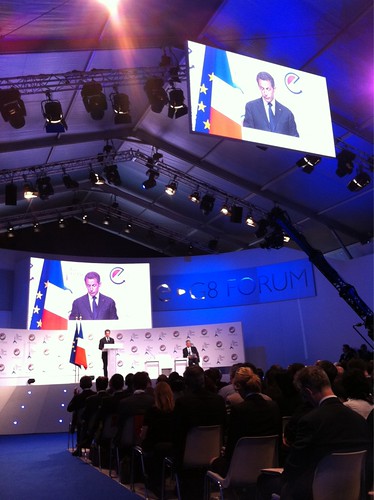
We’re in the middle of a new industrial revolution. Over 2 bilion people are connected to the Internet – a third of the world’s population and three billion have cell phones. Internet and mobile use is exploding in emerging economies, even contributing to the Arab Spring this year. Meanwhile the worlds developed economies are dealing with the breakdown of copyright and IP because of the Web, and the radical transparency brought by things like Wikileaks and the subsequent amplification of news via social media. So it’s almost amazing that it’s taken this long to have a special “e-G8″ conference to address the rise of technology as a new force in globalisation before the ‘real G8′ meeting.

Hopes are high. Some 1,500 people – tech gurus, entrepreneurs, VCs, big brand tech companies – are attending the event, which is in several huge tents in the Tuileries Garden in Paris. Attendees include Eric E. Schmidt of Google, Mark Zuckerberg of Facebook, Jeffrey P. Bezos of Amazon and Rupert Murdoch of News Corp.

And the agenda, at least on the face of it, looks high minded enough.

But there is also the political aspect. President Nicolas Sarkozy has no doubt timed this to amplify his prestige prior to the G8, and to kick his political opponents while they are down – namely former IMF head Dominique Strauss-Kahn, who languishes in New York. And chairman of Publicis, Mauarice Levy, said Sarkozy wanted the conference to be like the Internet: “Open Participative and, in a word, free.”

But is it?

Of course that chooses to ignore that France itself has among the most draconian Internet laws in the Western world, especially around file sharing. And let’s not mention the French obsession with privacy, which is daily blown apart by social platforms like Facebook and Twitter.

Sarkozy made a grand speech. Here’s a choice quote: “History happens when the creative forces of an era wish to converge.”

He went on to talk about the internet revolution as a third era of globalisation after the doscovery of the new world, and the industrial revolution. He even talked about radical transparency and the “dematerialisation” of information (perhaps he’s been watching Star Trek?)

But the crux of his argument was that although “Technology is neutral, but the way it’s used is not.” Hint: The agenda here is about whether we can lock things down. So thus the underlying themes of this conference are not openness and transparency but net neutrality, copyright and stopping the emergence of “new monopolies where older ones have been torn down,” as Sarkozy put it.

That’s code for the emergence of Facebook, Google and Twitter and other ‘platforms’ like Bitorernt where creative people suddenly have to start thinking radically differently about how to make money in a world where record labels don’t hold all the cards.

So if this is a new industrial revolution, what does that mean?

In the 19th century, as Europe raced to capitalise on the economic boom that was the industrial revolution, steam engines were at the heart of this change.
They powered the machinery that helped us mine for coal. They powered the trains that reduced journey times to a fraction of their previous length. And steam engines powered the early battleships battleships that ultimately contributed to the First World War.

But steam engines were built all over the world.

So if we are to accept that today, in 2011, we are experiencing an industrial revolution in information, data and platforms, why is it that developed countries – especially in Western Europe – are “importing” our steam engines rather than making them here?

What are today’s steam engines? Platforms. Platforms like Facebook, Twitter and LinkedIn.

In the era of the platforms created by mass market consumers and business use of software “as a service”, software has become globalised to an even greater extent.

Third party applications and entire startups have been built onto these platforms, leveraging their mass market scale and easy access to consumer. Why bother creating an entirely new social network when you can simply integrate Facebook profiles into your startup?

And who needs to get on a plane, or create “truck roll” in order to do that, right?

This is the platform world we now live in.

And this is the world that the eG8 is missing. It is all very well to talk about how ‘The Internet’ is enlivening our economies. But if we do that all we are talking about is the ‘rails’ on which all this stuff runs.

It’s now the platform that counts, not just the Internet itself. Without platforms, the rest of the world is ceding its new industrial production to players with rythless ability to scale globally.

It was telling that despite talking about the Arab Spring Sarkozy failed to mention Facebook and Twitter even once. He only mentioned ‘The Internet’.

This is in particular a message for Europe – we need to realise that the Internet is not the platform any more. We need platforms with scale, and we won’t get them by building a dating site in Estonia or a Twitter clone in Germany.

We must build out own steam engines now.

Sarkozy talks, King Carnute like, about the “responsibilities” of the technology industry to not create new monopolies out of the ashes of the old media and content industries.

He is in effect asking the technology world to drive with a man with a red flag in front of it.

Something tells me that practice didn’t last long in the last industrial revolution, and it won’t last long in this one either.

Advertisement
  • http://twitter.com/rodolfor Rodolfo Rosini

    Hopefully the EU will not fund a Facebook-killer, since it worked so well with their previous Google-killer – see Quaero http://en.wikipedia.org/wiki/Quaero

  • jean-cédric THÉROND

    I’m French… (yeah french bashing allowed, I don’t give a s…)
    And Sarkozy is REALLY unpopular, He’s just another liar/politic that plant too huge words for him in expect to monopolizing the attention, earning cash and muzzling the truth… Look closely to his actions…
    DADVSI… HADOPI… LOPPSI…

    Seriously, He’s just afraid of the Interwebs and crave to put fe(n)ces in our prairy…

    To make story short, he’s has a severe case of netophobia (phobia as in xenophobia, fear/hate of unknown)…

    I think I’ll expatriate myself in Iceland… Learn Icelandic language… and finally take the nationnality.

  • http://twitter.com/YJDdave David Caldwell

    Interesting- nice analogy to the growing pains/ regulation of the transport revolution- the red flag law, very apt.

  • http://twitter.com/mikebutcher Mike Butcher

    I’m not talking about a Quaero I’m talking about governments getting out of the way and letting entrepreneurs create the platforms

  • Georges

    Sarkozy is REALLY unpopular…… among leftists !
    BTW I agree that DADVSI… HADOPI… LOPPSI… (etc.) are “sh*t laws”.

  • People-oriented

    “But steam engines were built all over the world.” – the logical analogy for the steam engines in your article, is: ‘apps’ and ‘blogs’, rather than platforms.

  • Georges

    “He even talked about radical transparency and the “dematerialisation” of information (perhaps he’s been watching Star Trek?)” : in France, we use “dematerialisation” for “digitalization”.

    But there is something really scarry in this “e-G8″ :

    Intellectual Property and the Culture Economy in the Digital Age
    Antoine Gallimard (Chairman and CEO, Editions Gallimard),Jim Gianopulos,Frédéric Mitterrand (France’s Minister of Culture and Communication),Pascal Nègre (President and CEO, Universal Music France),Hartmut Ostrowski (Chairman & CEO, Bertelsmann AG),Moderator: Bruno PatinoALL (yes : ALL) the participants are well known for their stone-age like ideas when it comes to “intellectual property” :-(

  • Georges

    “He even talked about radical transparency and the “dematerialisation” of information (perhaps he’s been watching Star Trek?)” : in France, we use “dematerialisation” for “digitalization”.

    But there is something really scarry in this “e-G8″ :

    Intellectual Property and the Culture Economy in the Digital Age
    Antoine Gallimard (Chairman and CEO, Editions Gallimard),Jim Gianopulos,Frédéric Mitterrand (France’s Minister of Culture and Communication),Pascal Nègre (President and CEO, Universal Music France),Hartmut Ostrowski (Chairman & CEO, Bertelsmann AG),Moderator: Bruno PatinoALL (yes : ALL) the participants are well known for their stone-age like ideas when it comes to “intellectual property” :-(

  • http://twitter.com/HadrienRaffalli Hadrien Raffalli

    totally agree with you for the french dinosaurs. They don’t understand that they have to find new ways to do business and that technology is as culturally important as the content it displays.

  • Jean Cedric T

    Then, accordingto recent polls, there is more leftiststhan others currently in France ;)
    BTW… I’m not leftist… I’m democrat :P

  • http://twitter.com/thibaudj Thibaud Jurquet

    Not just among leftists. I voted for him in 2007, won’t do that again. Things like HADOPI, LOPPSI or ACTA are sh*t.

  • Steve

    The only agenda there is and ever was is “helping people out of their money”.

  • http://twitter.com/thibaudj Thibaud Jurquet

    What bugs me the most is that ALL of the speakers of Plenary IV (Intellectual Property and the Culture Economy in the Digital Age) are big media players from majors, publishers, studios, … just look at the list :
    - Éditions Gallimard 
    -20th Century Fox
    - Minister of Culture & Communication, France (HADOPI)
    - Universal Music France
    - Bertelsmann
    - France Télévisions 

    We all know where it’s gonna end : they’ll say that IP needs to be protected at all costs, DRM is a good thing…

  • Georges

    Polls, hum, what can I say…..

    Yes : they’re totally accurate : remember April 2002 :-) ))))))))))))))))))))))))
    BTW, French “right” is at the left of most of other country “left”, and voters change their mind every 5 minutes. Only one thing is stable : ALL the politics wants to “control” the Internet (and don’t understand what it is) :-( ((

  • Georges

    The problem is that it isn’t only an “Internet thing” : politician’s job is to pretend they can help by controlling everything.

  • Geeuru?

    Due to a combination of intelligent people not having children and
    excessive breeding by less intelligent people, the world is full of
    morons, with the exception of an elite few who work slavishly to keep
    order. Sarkozy, who was a shrewd con man in his day, has a solution to
    sell to sell the elite.

  • http://www.fbisdown.com/facebook-news/facebook-google-moguls-in-paris-as-sarkozy-bids-for-web-regulation-forbes-blog-2/ Facebook, Google Moguls In Paris As Sarkozy Bids For Web Regulation – Forbes (blog) – Facebook Is Down

    [...] Journal ConstitutionSarkozy pushes for global internet rulesGlobalPostMarketplace -TechCrunch -Spiegel Onlineall 383 news articles » Categories: Facebook News 24 May 2011 [...]

  • http://www.backupoutlook.com/ Alice Ward

    Technology is neutral, but the way it’s used is not.” Hint: The agenda here is about whether we can lock things down.

    - Exactly. This is what the future has become. Since the knowledge about the web is not limited to a few people, there is a higher risk of being exposed! The Internet may seem to be floating but it’s too powerful  – it can even make or break a country. Well, that may be a little exaggerated but you get the point.

    Internet is helpful in today’s generation but we still need to use it responsibly.

  • http://tutomonodeb.wordpress.com/2011/05/24/the-e-g8-talks-of-a-new-industrial-revolution-but-where-are-the-steam-engines/ The e-G8 Talks Of A New Industrial Revolution ? But Where Are The Steam Engines? | tutomonodeb

    [...] Read the rest of this entry ? [...]

  • http://kycokanir.wordpress.com/2011/05/26/the-e-g8-talks-of-a-new-industrial-revolution-but-where-are-the-steam-engines/ The e-G8 Talks Of A New Industrial Revolution ? But Where Are The Steam Engines? | kycokanir

    [...] Read the rest of this entry ? [...]

  • Jackpetitpied

    I don’t understand why everybody was so freaked out about Sarkozy’s possible grab on the Internet.
    There is an interesting article here about a rather positive and objective view about the outcomes of the Eg8: http://www.managementtoday.co.uk/opinion/1072053/mt-special-learned-weeks-eg8/ 

  • Jackpetitpied

    I don’t understand why everybody was so freaked out about Sarkozy’s possible grab on the Internet.
    There is an interesting article here about a rather positive and objective view about the outcomes of the Eg8: http://www.managementtoday.co.uk/opinion/1072053/mt-special-learned-weeks-eg8/ 

  • http://familyvacationssun.freemanchronicles.com/44/the-e-g8-talks-of-a-new-industrial-revolution-but-where-are-the-steam-engines/ The e-G8 Talks Of A New Industrial Revolution ? But Where Are The Steam Engines? | Family Vacations Sun

    [...] Read the rest of this entry ? [...]

  • http://twitter.com/thibaudj Thibaud Jurquet

    Allroght i’m a bit late… 

    Anyways we are kind of freaked out about this because Sarkozy has already tried to do this in France, by implementing laws that allow a user’s web connection to be disconnected, or a website to be blocked without involving a judge. 
    Oh, and he said so in his speech at the opening of the conference.

blog comments powered by Disqus
Advertisement